Air conditioning beats the heat, but without proper ventilation a home still feels stuffy. Here is how to choose a system, where to place the units and how to look after them.
Building services and smart home
·
Air conditioning and ventilation in a hot climate: how to choose well
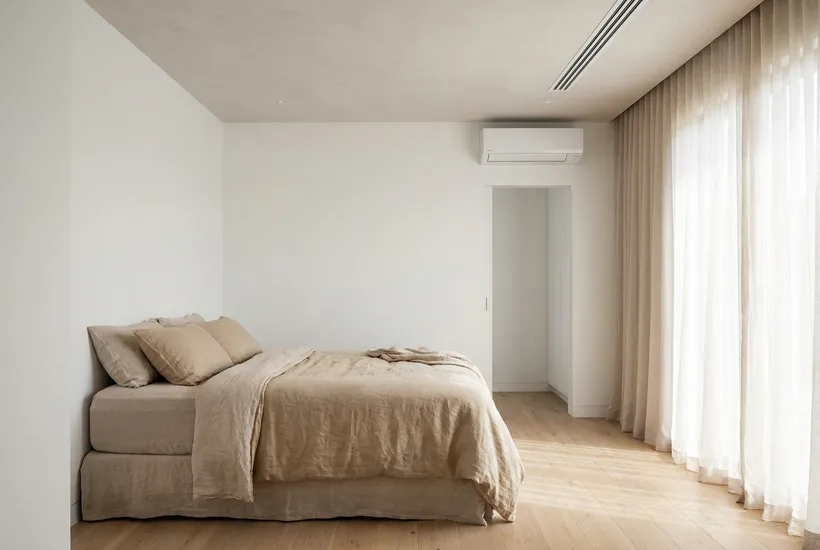
In summer the air conditioner runs almost non-stop, and any mistake in choosing it soon makes itself felt: noise right by the bed, a jet of cold air aimed at the sofa, high electricity bills. Yet an air conditioner only cools and dries the air. It brings in no fresh air at all. That is why, when choosing air conditioning, your indoor climate needs thinking about on two fronts at once: cooling and ventilation.
Which system to choose
- Split system: one outdoor and one indoor unit. A simple, straightforward solution for one or two rooms.
- Multi-split: one outdoor unit serves several indoor ones. Fewer units on the facade, but if the outdoor unit fails, every room loses cooling at once.
- Ducted system: the indoor unit is hidden above a suspended ceiling and air travels through ducts to grilles in each room. Almost invisible, but it needs spare ceiling height and has to be planned during the renovation.
Capacity is not chosen “by square metres” alone: window orientation, insulation, ceiling height and the number of people in the room all count. This is a calculation, not a guess, so leave it to a specialist.
What information is needed to size the system and estimate running costs
To have the installer calculate the load rather than pick a unit by eye, prepare some details for each room. In Cyprus, sun and heat strongly affect the result, so floor area alone is not enough.
- Which way the windows face and at what time of day direct sun comes in.
- The size of the glazing and whether there are shutters, blinds or awnings.
- Wall and roof insulation: a top-floor flat under a flat roof heats up differently from one lower down.
- Ceiling height and open passages to other rooms.
- How many people are usually in the room and whether any equipment gives off heat, such as a computer or a cooker.
- When the room is used: a bedroom at night, a study during the day, the living room in the evening.
Comparing running costs needs different data: your electricity tariff from the bill, the expected operating pattern, whether you need heating in winter, and the energy-efficiency figures the manufacturer states for cooling and heating. Ask different contractors to work from the same input data. Only then can their proposals be compared. If the house is near the sea, ask how the outdoor unit is protected against salty air and what the manufacturer’s instructions say about it.
Where to place the units
The indoor unit should not blow onto the bed, the desk or the sofa. It is better to direct the airflow along the ceiling or towards a walkway, since cold air will sink by itself. Do not mount the unit above a wardrobe or in a deep recess: it needs free space to draw in air. Place the outdoor unit where it can be reached for servicing, where warm air can escape freely and where the noise will not bother you or your neighbours. Plan the condensate drain too: the pipe must run with a fall, and the water must not trickle down the facade. How indoor units are placed in real rooms can be seen in the gallery of ventilation and air conditioning projects.
How to keep it quiet
Quiet operation depends on both the model and the quality of installation. Inverter systems adjust their output smoothly and are quieter than units that keep switching on and off. For a bedroom, check the noise level at the lowest fan speed and look for a night mode. The outdoor unit is mounted on anti-vibration feet and never right under a bedroom window.
Ventilation: the part people forget
Closed windows and a running air conditioner mean cool but stale air. A home needs a supply of fresh air and extraction from the bathroom and kitchen. The most comfortable option is mechanical ventilation with heat recovery: it renews the air while losing very little of the coolness. Without such a system, keep the extractor fans in working order and air the rooms in the cooler morning and evening hours.
Heat pump or air conditioner
A split system with a heating mode is already a heat pump: it moves heat between the outdoors and the room and can warm the house in winter. So the real question is usually different: will room air conditioners be enough, or does the house need a separate air-to-water system that heats water for underfloor heating, radiators and the taps?
When air conditioners are enough
- An apartment or a small house where summer cooling is the main job and warm air is enough in winter.
- You need to condition individual rooms that are used at different times.
- No major renovation is planned, and there is nowhere to run heating pipes.
When an air-to-water heat pump is worth considering
- A house where you want even warmth across a whole floor, for example through underfloor heating or radiators.
- You need hot water for showers and the kitchen, and the existing water heater is due for replacement.
- A major renovation or a new build is under way, so pipes can go into floors and walls from the start.
The two are often combined: a heat pump handles heating and hot water, while air conditioners or fan coils take care of summer cooling. Which option makes more sense for your home depends on insulation, floor area, how your household lives and energy tariffs. It is a matter of calculation, not a rule of thumb. Examples of finished installations are collected in the heating and boiler room project gallery.
What to ask the installer
- How did you size the system, and which information about the house did you use?
- Will the system only heat, or cool as well, and with what?
- Where will the outdoor unit go, how loud is it, and how will it be reached for servicing?
- Is a hot water cylinder or a buffer tank needed, and where will it fit?
- How will the system work with existing radiators, underfloor heating or a solar water heater?
- What does the quote include: equipment, pipework, electrical work, commissioning, removal of packaging?
- What warranty covers the equipment and the installation, and who services it and how often?
Compare quotes for the same brief: if one installer prices air conditioners only and another a system with hot water, the totals cannot be compared. You can find specialists in heating and boilers and in ventilation and air conditioning in the Cozy catalog.
Maintenance and when to call a professional
- Rinse the indoor unit filters regularly during the season (it is easy to do yourself).
- Have a technician clean the heat exchangers and the drain and check the whole system as set out in the equipment manufacturer’s instructions, taking into account how heavily the system is used.
- An unpleasant smell, dripping from the unit, weak cooling or ice on the pipes are reasons to call a specialist, not to start repairs yourself.
Frequently asked questions
How much does air conditioning installation cost?
There is no single figure, because the price depends on the system and the house. Published figures for the average cost of central air conditioning installation say little about a ducted system in your home, where the duct routes, the ceiling void and the number of grilles differ from house to house. The same is true of the average cost of split system air conditioning installation: the total depends on the number of indoor units, the length of the refrigerant lines, the electrical work and access to the outdoor unit. So instead of relying on the average cost of an air conditioning unit and installation, ask several installers to price the same brief and compare what each quote includes.
Is an air conditioner enough to ventilate a flat?
No. An air conditioner cools and circulates the air inside the room but, as a rule, does not bring in fresh outdoor air. Supply and extraction are solved separately: by airing the rooms, extractor fans in the bathroom and kitchen, or a mechanical ventilation system. Ask a ventilation specialist what fits your layout.
When does cleaning the filter not fix weak cooling?
If the unit still cools poorly after the filters are rinsed, the cause may lie elsewhere: a dirty heat exchanger, a fault, a refrigerant leak or simply too little capacity for the room. A technician identifies this during diagnostics; do not try to recharge or dismantle the system yourself.
Installation, with refrigerant lines, vacuuming and the electrical connection, is a job for a professional. If your renovation is still ahead, bring in a building services specialist before the walls are plastered and the ceilings closed: pipes and ducts are easier to hide in walls and ceilings now than to box in later. You can find the right specialist in the Cozy catalog.
Other articles
A smart home without overspending: where to start
A smart home does not have to mean an expensive system and dozens of gadgets. Here is which features are genuinely useful, how wired and wireless solutions diff...
Building services and smart home