Flat concrete roofs overheat in summer and leak with the first winter storms. Here is why it happens, which materials to consider and how to prepare a roof for waterproofing.
Roofing and facade works
How to waterproof a flat roof and stop leaks
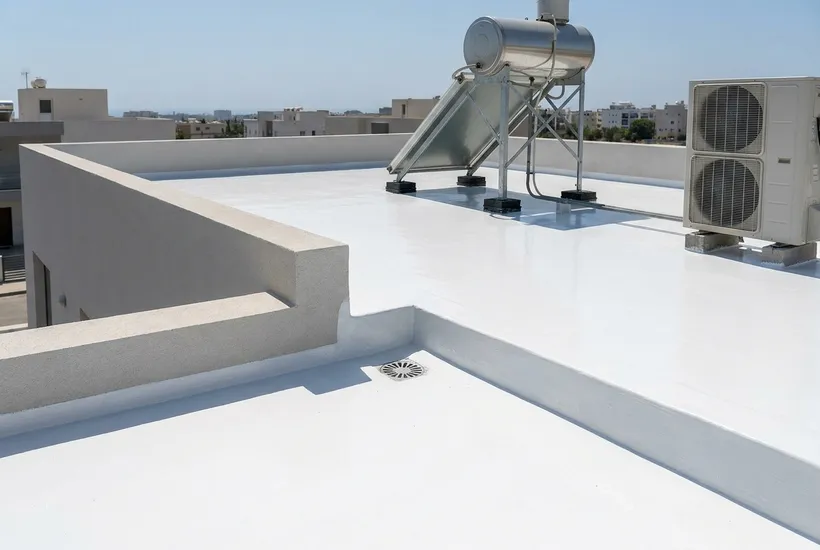
Flat concrete roofs are the norm in Cyprus: they carry solar water heaters and outdoor air-conditioning units, and some double as terraces. That makes waterproofing flat roofs here a demanding job. Strong summer sun and heat age and crack old coatings, and the first winter storms reveal every weak spot, often around the fixings of a solar water heater. This guide covers why flat roofs leak, how membranes and liquid systems differ, where reflective coatings and insulation fit in, how to prepare the surface and what to ask a contractor.
If damp has already appeared indoors (stains, mould, a musty smell), start by finding its source; our article on damp and mould in Cyprus homes deals with that.
Why flat concrete roofs leak
Water drains off a flat roof more slowly than off a pitched one, so any weak spot shows sooner or later. The usual culprits:
- Thermal cracking. Concrete and coatings heat up by day and cool at night; over time an old layer loses flexibility and cracks, especially over joints and along the edges.
- Upstands and junctions. Where the roof meets a parapet, a wall or a roof access, leaks are common if the waterproofing was not taken up the vertical surface.
- Equipment fixings. Supports for solar water heaters, air-conditioning units and aerials, plus pipe penetrations, break the continuity of the layer. Every anchor hole is a possible path for water.
- Ponding. If the fall is too shallow or the outlet is blocked with leaves and sand, puddles stay after rain and water sits over weak spots for longer.
- UV ageing. Sunlight gradually breaks down many coatings: chalking, blisters and peeling follow.
A ceiling stain is rarely directly below the point where water got in: it can travel sideways through layers and cracks. Patching only above the stain is often wasted effort.
Bitumen and synthetic membranes
Most flat roof systems fall into a few groups. The right one depends on the condition of the deck, how many details and pieces of equipment the roof has, whether people will walk on it and what is on it now.
- Bitumen membranes come in rolls laid as a continuous layer with overlapped, torched or bonded seams. The result is durable, but how the seams and upstands turn out depends entirely on the installer. Many bitumen membranes need protection from the sun, such as a mineral finish or a protective coat.
- Synthetic membranes, such as EPDM and other polymer sheets, go down in large pieces with few seams; careful detailing at upstands and penetrations is what matters.
Ask the contractor to name the specific system and show the manufacturer’s data sheet: which substrate it suits, how many layers it needs, how it copes with UV and whether it can be walked on. Check compatibility too: not every product can go over another.
Liquid waterproofing for flat roofs
Liquid waterproofing for flat roofs is applied by brush, roller or spray and cures into a continuous, jointless layer. It suits roofs crowded with supports, pipes and corners. What counts is the thickness and number of coats and reinforcing fabric over cracks and junctions. A waterproof sealant for flat roofs is useful around individual fixings and small joints, but it does not replace a continuous layer.
Waterproof paint and reflective coatings for flat roofs
Waterproof paint for flat roofs and other waterproof coatings for flat roofs are often light-coloured and reflective, which helps reduce how hot the roof surface gets and shields the layers below from direct sun. A few caveats:
- Not every reflective coating is waterproofing. Some are sold as waterproof systems, others only reflect sunlight and go over an existing waterproof layer. Check the data sheet before buying.
- Dust, sand and dirt reduce reflectivity. Clean the roof gently from time to time; use a pressure washer only if the manufacturer allows it.
Insulation under or over the waterproofing
Insulation can go under the waterproofing or on top of it. In an inverted roof the insulation boards sit above the membrane and protect it from sun and foot traffic. Which build-up suits your house depends on the slab, the load it can take and what is already there, so decide it with a specialist.
Preparing the surface and the fall to drains
Even a good product will not hold on a poorly prepared deck. Preparation usually means:
- Removing debris, dust and anything loose, including flaking areas of the old coating.
- Repairing cracks in the screed; show larger cracks to a specialist before covering them.
- Letting the surface dry: most materials go onto a dry base, so work stops after rain.
- Reinforcing details: corners, upstands, outlets and penetrations get an extra layer or reinforcing tape.
After rain, note where puddles remain and correct ponding before waterproofing, with a levelling screed or an extra outlet. If an old coating is sound, dry underneath and compatible, a new layer may go over it; if it is blistered, peeling or the screed beneath is wet, it comes off. Test openings in a few places show what lies below.
Choosing a roofing contractor
You can find roofers in the roofing and facade works section of the Cozy catalogue and see finished jobs in the roofing and facade project gallery. For an independent check of preparation and hidden layers, consider technical supervision; if you are not sure what is wrong with the roof, start with a construction inspection.
Post a request with photos of the roof, the equipment on it and any signs of leaks inside, then compare offers. To compare like with like, ask each contractor to describe:
- the system proposed and how many layers it has;
- what preparation includes: cleaning, crack repair, stripping the old coating, correcting the fall;
- how upstands, outlets and equipment fixings will be detailed;
- whether the water heater and AC units must be moved and who will do it;
- the weather needed for the work and how the finished roof will be checked.
If you rent the property out or live abroad, agree on a photo record of each stage in advance. Check local requirements for roof work and rooftop equipment with a specialist.
Frequently asked questions
How often should a flat roof be re-waterproofed?
There is no single interval: it depends on the system, sun exposure, foot traffic and how well the roof is maintained. Inspect it at least once a year, ideally at the end of summer, and after heavy storms. Recoat or repair when you see cracking, blistering, peeling or worn areas, rather than waiting for a leak indoors.
Is waterproof paint enough for a flat roof?
On a sound roof with good falls and intact details, a waterproof coating rated for roofs can be a reasonable refresh. It will not fix ponding, wide cracks, a wet screed or failed upstands, and some reflective paints are not waterproof at all. Check the data sheet and have the roof assessed before relying on paint alone.
Can a roof with solar heaters be waterproofed?
Yes. The contractor either works carefully around the supports, sealing each fixing, or the water heater is temporarily disconnected and lifted so the area beneath can be treated. Agree in advance who disconnects and reconnects it, and consider supports on protective pads instead of anchors drilled through the new layer.
When is the best time of year for roof waterproofing?
Usually the dry season, when the deck can dry out fully, avoiding the hottest days if the manufacturer limits application temperature. Aim to finish before the first winter rains, so leaks do not catch you by surprise and the contractor has time to prepare the surface and details properly instead of rushing.
Other articles

Damp and mould in Cyprus homes: finding the cause
Marks on walls come back after repainting until the water source is found. How to record what you see, tell condensation from a leak and choose who to call for ...
Roofing and facade works