Ten interior ideas worth considering right now, and why they are a response to how we live at home rather than a one-season fashion.
Interior design
·
10 interior trends that are here to stay
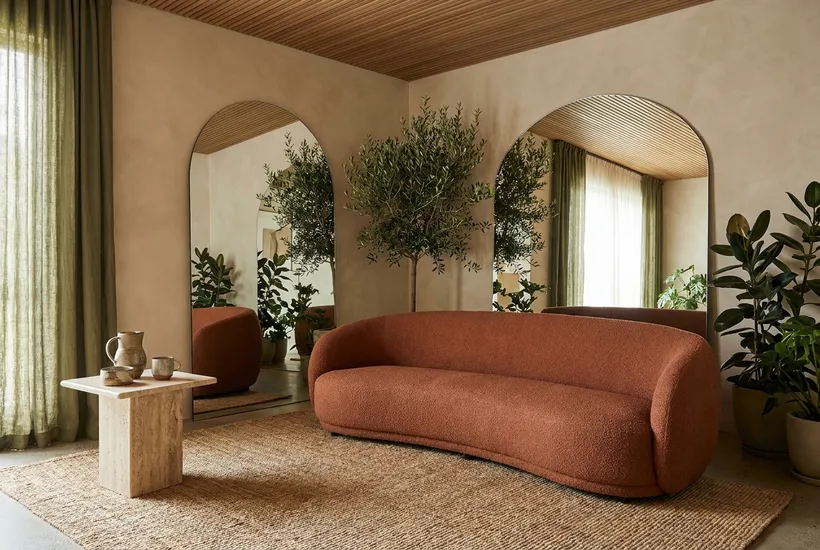
Interior design trends no longer change every season. We spend more time at home, and what people ask designers for has become more practical: cosy, durable and free of clutter. Here are ten directions worth considering if you want changes that last.
This is an editorial selection rather than a ranking or market statistics. The first four ideas are about colour, texture and shape. The next three cover how a room works, from the workspace to light and storage. The last three add character and practicality: pieces with a story, plants and saving resources. Read them as a menu: from each group, take what suits your home. To see how these ideas work in real homes, browse the interior design project gallery.
1. A warm palette instead of cold grey
Grey-and-white interiors are giving way to sand, terracotta, olive and caramel tones. Sage green suits these interior design trends too, alongside the warmer shades. A warm background softens the light and makes even a small room feel cosier.
2. Natural materials
Wood, stone, linen, handmade ceramics. People choose them not only for their looks: these materials age beautifully, and a scratch on solid wood is easy to sand out.
3. Soft, rounded shapes
Sofas with curved backs, arched openings, oval tables. Flowing lines feel calmer and are safer in a home with children.
4. Textured walls
Decorative plaster, limewash, microcement. Texture gives a wall depth without a pattern and hides small irregularities in the surface.
5. A workspace that doesn’t get in the way of rest
A study in a niche, a fold-down desk in a cabinet, a partition in the living room. The key is for the work area to “disappear” from view after hours.
6. Lighting scenes
Instead of a single ceiling light, you get several sources: general light, task lighting over the table and work areas, soft accent lighting for the evening, all controlled from a phone or by voice. Specialists in interior lighting design can help you plan the scenes.
7. Storage built into the architecture
Floor-to-ceiling cabinets, niches, benches with drawers. Built-in storage doesn’t clutter the room and saves the space separate furniture would take.
8. Pieces with a story
Vintage furniture, a reupholstered family armchair, work by local makers. One object with character makes an interior more personal than any catalogue décor.
9. Plants as part of the design
Greenery is planned from the layout stage: a spot by the window, grow lights, planters built into furniture.
10. Saving resources
Energy-efficient windows, A-class appliances, taps with aerators. These choices can help lower your bills and make the home more comfortable.
Light and a workspace: two scenarios for one room
Ideas 5 and 6 work best together. Take a living room that serves as an office by day and a place to unwind in the evening.
- By day, the desk sits to the side of the window so the sun doesn’t dazzle you or glare on the screen; curtains or blinds soften the strong Cyprus sun. A directional lamp lights the desk, and cables are gathered in trunking or an organiser.
- In the evening, the task light is off, the laptop goes into a drawer or behind a cabinet door, and the room is lit by a floor lamp, a table lamp and soft shelf lighting. The ceiling light is needed for little more than cleaning.
If there aren’t enough sockets or they are in the wrong place, sort this out before buying furniture: moving or adding sockets is a job for an electrician.
Built-in storage and vintage: where measuring and restoration matter
A built-in cupboard only looks like part of the architecture if it fits the niche precisely. Walls and ceilings are rarely perfectly straight, and there may be sockets, switches, an air conditioner or pipes nearby. That is why the maker of the furniture should take the measurements, and the final measurement is usually done once the walls are finished.
With a vintage piece, check the basics first: stability, the condition of the frame, drawers and veneer, signs of woodworm or damp. Leave reupholstering an armchair or restoring wood to specialists in reupholstery and furniture restoration: they will tell you whether the piece is worth the work. Humid sea air and air conditioning both affect wood and leather, so ask the restorer how to care for them.
Plants and natural materials in a sunny home
The sun that makes a Cypriot home bright also calls for care with materials. Direct light at south- and west-facing windows can fade linen, upholstery and wood, so choose fade-resistant fabrics near windows and draw curtains or blinds during the day. Stone and ceramics cope with the sun more easily. Check how to care for a particular fabric or finish with its manufacturer.
Choose plants for the light at a specific window, not for a picture: some struggle with scorching sun behind glass, others get too little light deep inside the room. Air conditioning dries the air, so don’t put pots directly in the airflow. If in doubt, ask at a garden centre how a plant behaves in similar conditions.
Two ideas on a budget: an example of a limited update
Picture a living room with grey walls and a sofa you are happy with. Instead of renovating, you choose two ideas: a warm palette and lighting scenes. The palette goes into textiles (a throw, cushions, curtains and a rug in sand and olive tones), and you repaint the walls only if the grey really bothers you. For lighting, you add a floor lamp by the sofa and a table lamp, keeping the ceiling fitting as general light.
Everything else, from built-in cupboards to textured walls and new furniture, goes on a list for later. An update like this can be done step by step, so you can see how the room lives with the changes before deciding what comes next.
Frequently asked questions
Which interior ideas can be done without a major renovation?
Without serious work, you can usually change textiles and the colour palette, add lamps and lighting scenes, reupholster, restore or rearrange furniture and refresh your plants. Built-in storage and textured walls generally need measuring and preparation, so discuss them with a maker or designer.
How do I combine a warm palette with furniture I already own?
Start with what stays: look at the colour of the wood, upholstery and floor, and pick warm shades that go with them: sand, terracotta, olive or sage green. The easiest way to bring in new colour is through textiles and décor; paint the walls only after testing samples in daylight and in the evening.
Where to start
You don’t need to do everything at once. Pick two or three ideas that speak to you and discuss them with a designer, who will help fit them to your layout and budget. You can find a specialist under interior design in the Cozy catalog or, for a flat or house, go straight to residential interior design. For inspiration, look through photos of finished living spaces by local designers.