Choose trees for the space they will occupy as adults, not their nursery size. Compare shade, fruit, evergreen screening and the water each choice will need.
Garden design and planting
Good trees for small gardens: shade and shrubs in Cyprus
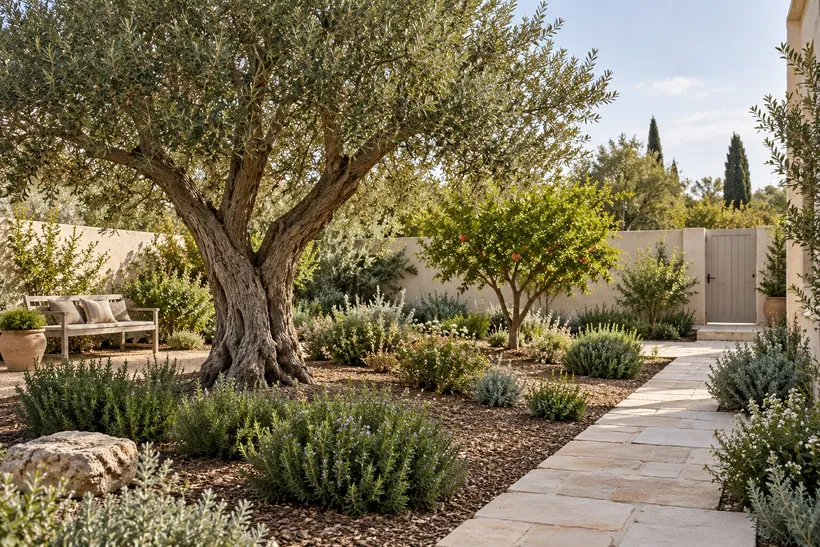
Good trees for small gardens are the ones that fit the site when they are mature. In Cyprus, a tree may need to shade a terrace, soften a boundary and survive long dry summers, all within a few metres of paving or a pool. Those demands cannot be answered by a single “best tree” list. Start with the space for roots and crown, then match the species, variety and watering commitment. This guide focuses on trees and shrubs; the wider layout is covered in planning an easy-care garden.
What to check before choosing a tree
Draw the house, pool, walls, drains, buried services and existing trees. Record where shade is wanted at the time you actually sit outdoors. A tree south of a seat does not necessarily shade it during a late western sunset. Look at reflected heat from pale walls and paving, and at wind corridors between buildings. A sheltered courtyard in town and an exposed coastal plot can need different planting despite being nearby.
Ask the nursery for the botanical name, named cultivar where applicable, expected local mature height and crown width, and rootstock for grafted fruit trees. “Dwarf”, “compact” and “standard” describe different things: a standard has a clear stem, but its crown may still become broad. A small pot is not evidence of a small adult tree. Allow room to maintain the crown without making severe pruning an annual necessity.
- Soil: check depth, compaction, drainage after rain and any rubble left by building work.
- Water: establish the available supply and whether its salinity needs testing, especially when using a borehole.
- Use: decide between summer shade, winter screening, fruit or a focal point; one plant rarely delivers everything equally well.
- Management: include leaf and fruit collection, pruning access and someone to inspect irrigation while the house is empty.
Evergreen small trees for gardens and shade
Evergreen small trees for gardens keep structure through winter, but their shade also remains when you may want sunlight indoors. An olive, Olea europaea, suits a sunny, well-drained position and gives filtered shade through its narrow leaves. Its eventual dimensions depend on the selection and management; a mature olive is not automatically a miniature tree. Place fruiting forms where fallen olives will not stain the principal walking route or pool edge.
The RHS olive profile confirms the preference for sun and good drainage. Nursery size estimates should still be checked for Cyprus rather than copied directly from a UK growing profile. Ask about the actual cultivar and the maintenance needed to keep the intended form. An expensive old specimen also needs a carefully planned establishment period; age does not remove transplant stress.
Carob, Ceratonia siliqua, can provide substantial evergreen shade and tolerates drought once established, but its broad adult crown makes it a choice for a suitably spacious plot. It should not be presented as a universal small-garden tree. In a tight courtyard, a smaller suitable tree combined with a pergola can be more realistic than forcing a large canopy into a narrow bed. See terrace types and shading for the built part of that solution.
Compact fruit trees: citrus, olive and pomegranate
Fruit changes the brief. A tree that survives a dry summer may not produce a worthwhile crop without additional water. Citrus offers evergreen foliage, fragrant flowers and useful fruit, but needs dependable irrigation and a suitable rootstock. Choose a variety you will actually harvest, with enough access to inspect leaves and remove fallen fruit. Do not put a lemon on the same watering schedule as an established low-water shrub simply because both look Mediterranean.
Pomegranate, Punica granatum, can be grown as a small tree or a multi-stemmed shrub and loses its leaves seasonally. It tolerates drought after establishment, while a useful crop benefits from more consistent moisture. Large fluctuations during fruit development can contribute to splitting. Confirm that the cultivar is grown for edible fruit: ornamental dwarf forms are not an equivalent substitute for a productive orchard variety.
A fig can be appealing, but needs a generous, considered position away from vulnerable structures and services. Its growth and root behaviour make a narrow bed beside a pool a poor default choice. Fruit, sticky residues and insects also matter near seating. For any fruit tree, ask about pollination requirements and harvest timing; a household absent during ripening may prefer a non-fruiting ornamental or a smaller harvest.
Small trees for the front garden and narrow spaces
Small trees for the front garden must leave sightlines, gates and access clear as they grow. A narrow crown can fit a restricted frontage, but does not imply an equally narrow root system. A multi-stemmed tree creates attractive structure at eye level while using more width near the ground. Choose between these forms by drawing their adult outline, not by comparing the height of nursery stock.
The best small trees for small gardens also leave workable soil around them. A tiny opening cut in paving can limit water infiltration and root space. Discuss a larger planted strip or connected soil area before choosing a fashionable specimen. Avoid planning a tree directly over a drain or service access point. Root barriers, where justified, need a site-specific design and are not a guarantee that any species can be planted anywhere.
There is no universal “non-invasive root” label and no single safe distance from every house. Soil, foundations, pipe condition, species and adult size all affect the decision. Deep-rooting descriptions are particularly misleading when used as a safety promise: roots also grow laterally where air and moisture are available. An arborist or landscape professional should assess difficult positions before planting or before cutting existing roots.
Shrubs for screening, flowers and coastal conditions
Mastic or lentisk, Pistacia lentiscus, is an evergreen Mediterranean shrub worth considering for a sturdy screen, subject to local exposure and available width. Myrtle, Myrtus communis, offers small leaves, white flowers and a more detailed texture near paths. Compact selections differ from the full-sized species, so specify the plant rather than simply asking for “myrtle”. Both need room for their natural shape or an agreed clipping regime.
A mixed boundary can avoid the severe visual gap that appears when one plant fails in a single-species hedge. Group plants with similar watering needs and leave a maintenance route inside the boundary. A screen that filters wind may be more comfortable than a completely solid enclosure. Consider winter appearance, flowers and berries together; clipping every surface frequently can remove much of the flowering growth.
Oleander, Nerium oleander, is common in sunny Mediterranean planting, but all parts are toxic if eaten and its smoke is harmful. It is not a casual choice beside children's play or where pets chew plants. Do not burn its prunings. Where that risk is incompatible with the household, select another shrub rather than relying on a decorative label to manage the problem.
Salt in the soil and salt spray on leaves are different stresses. A species listed as coastal is not guaranteed to thrive in the first exposed row facing the sea. Ask a local nursery to distinguish direct spray, wind exposure and the quality of irrigation water. Observe healthy established planting on comparable nearby sites, while remembering that a mature shrub may tolerate conditions that a newly planted specimen cannot yet handle.
Planting and watering in the first years
On mild lowland sites, the cooler period after reliable autumn rain is often a useful planting window, allowing establishment before summer heat. Higher or frost-prone locations and tender species need a different schedule. Avoid planting into saturated soil or immediately before extreme heat. Buy healthy stock with a sound root system; an oversized tree in a cramped container is not automatically better value than a younger plant.
Find the root flare before setting the final planting depth. The transition from trunk to main roots should not be buried beneath a mound of soil or mulch. Prepare a sufficiently broad planting area, check drainage and water the root ball thoroughly. The University of New Hampshire planting guide illustrates root-flare placement and mulching; adapt species and seasonal timing to local conditions.
Drought tolerance describes an established plant, not permission to neglect a new root ball. Check moisture in the root ball and surrounding soil, and water according to actual drying, weather and soil rather than a fixed daily timer. Drip irrigation should wet an appropriate area and be adjusted as roots develop. A single emitter at the trunk forever is not a complete long-term plan. Keep mulch clear of the bark and ensure ties do not tighten as the trunk grows.
Containers need separate attention: their limited soil volume dries and heats faster, and roots cannot explore deeper ground. Use a stable pot with drainage, an appropriate substrate and an accessible watering arrangement. Plan eventual repotting or root management. A potted citrus may suit a courtyard, but it is a poor unattended option for a house closed throughout summer without reliable care.
Who should plan and plant the garden?
For species, sizes and planting work, compare specialists in garden design and planting. If trees interact with pool construction, levels or access, involve landscape architecture and site planning. The garden planting project gallery helps compare spacing and mature-looking compositions rather than simply counting plants.
Send a measured plan, photographs, the intended shade and privacy, your water supply and how often the house is occupied. Request botanical names, cultivars, delivery sizes, adult dimensions, soil preparation, irrigation zones and establishment visits in the quotation. Agree how substitutions are approved and what the plant guarantee covers. On Cozy you can compare professionals and their work; the selected specialist should explain the choices for your particular plot.
Frequently asked questions
Which trees have non-invasive roots?
No tree carries a universal guarantee for every position. Select an appropriate mature size, provide useful soil volume and check nearby structures and drains. If space is very restricted, a smaller shrub or a separately shaded seating area may be a better solution than a tree squeezed against the house.
Which trees give shade quickly?
Larger specimens offer a larger initial crown, but cost more and can take careful establishment. Fast growth also means more future space and maintenance. Compare the eventual tree with the available ground, and use temporary shade while a suitably sized young tree develops.
Can drought-tolerant trees be left without irrigation?
Not immediately after planting. Young trees need monitoring and water while their roots establish. Later needs depend on soil, exposure, species and whether fruit production matters. Agree a realistic establishment plan before buying, particularly if nobody is present during the hottest months.