




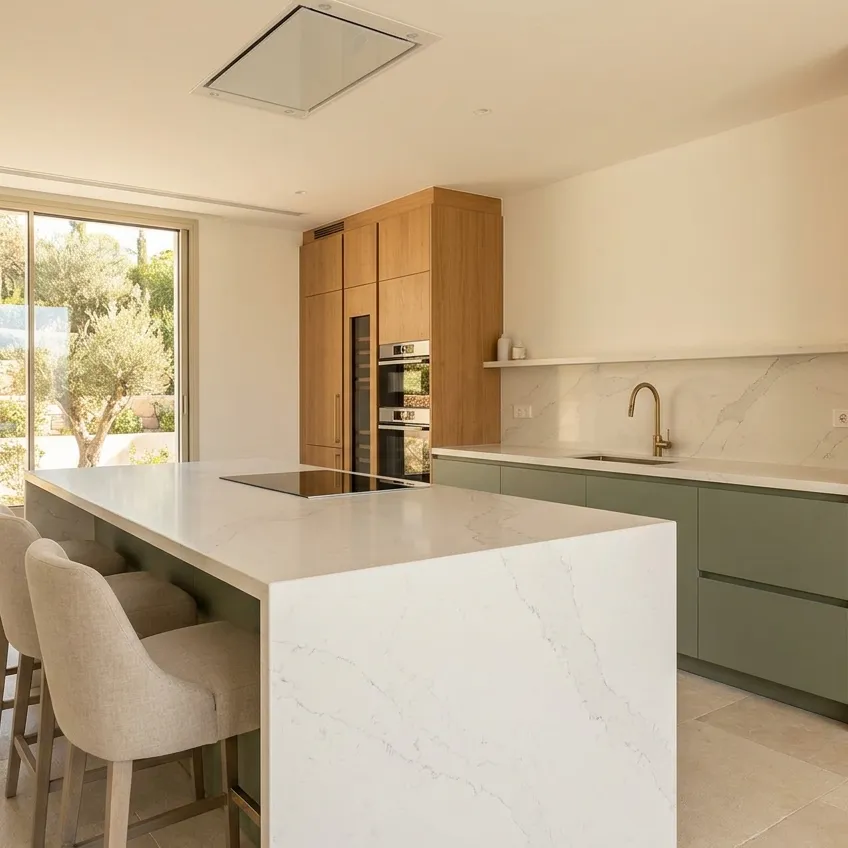






The countertop is the hardest-working surface in a kitchen: you chop on it, put pans down on it, spill coffee and wine on it. A stone or quartz countertop is made precisely to fit a specific kitchen, with cut-outs for the sink and hob. On Cozy you will find countertop fabricators, stone workshops and installers in Cyprus. They make kitchen countertops and island worktops, bathroom vanity tops, breakfast bars and window sills. Their profiles show project photos and reviews, as well as prices.
A job post with the kitchen dimensions and the material you are leaning towards is enough for a first estimate.
Quartz, natural stone or ceramic
Engineered quartz is a man-made stone based on quartz and a binder: dense, low-porosity, consistent in colour and easy to care for; manufacturers generally do not recommend it for outdoor kitchens. Granite is hard and scratch-resistant, and every slab has its own pattern. Marble is prized for its veining, but it is softer and sensitive to acids, so it needs sealing and careful use. Sintered stone and large-format ceramic resist heat, scratches and sunlight and also suit an outdoor kitchen on the terrace, but their thin edges need careful finishing and some care against impacts.
How a countertop is made
Work on a stone countertop follows a set order:
- choosing the material and slab (natural stone is best seen in person);
- a preliminary measurement and price estimate;
- installing and levelling the kitchen base units;
- accurate measuring or templating on the installed units;
- fabrication with cut-outs, then fitting and connecting the sink.
Final templating is only done once the base units are in: before that, dimensions can shift. Choose the sink, hob and tap in advance, since the cut-outs and holes are made for them.
Edges, cut-outs and joints
The edge profile affects both looks and practicality: a square edge with a small chamfer looks contemporary and chips less, while a rounded edge feels softer. The sink can be inset, flush-mounted or undermounted: an undermount sink is easier to keep clean but needs a polished cut-out. Drainer grooves and holes for the tap, soap dispenser and pop-up sockets are added as needed. Long and L-shaped worktops cannot avoid joints: the fabricator will show you in advance where they will fall and match the stone’s pattern. A splashback and upstand in the same material give a unified look.
Caring for a stone countertop
Clean quartz with mild products, without abrasives or harsh chemicals. Natural stone, especially marble, needs resealing from time to time, and lemon juice, vinegar and wine are best wiped up immediately. Use trivets for hot pans and a board for cutting. Many chips and scratches can be repaired and polished on site. For outdoor kitchens under the Cyprus sun, choose materials that are not affected by UV.
How to choose a countertop fabricator
Look in the portfolio for work in your chosen material and of similar complexity: an island, an undermount sink, a complex edge. Ask who measures and installs, what the price includes, whether there is a guarantee and whether the old worktop will be taken away. For a quote, attach a kitchen plan with dimensions, the sink and hob models and photos to your job.