






Decorative mouldings in Cyprus are the answer when an interior lacks a finished look: a clean line between wall and ceiling, a frame around a door or fireplace, classic panelling on the walls. Cozy brings together specialists who select, make and install mouldings and decorative elements (ceiling cornices, wall mouldings, ceiling roses, pilasters, half-columns and architraves) in apartments, villas, restaurants and hotels.
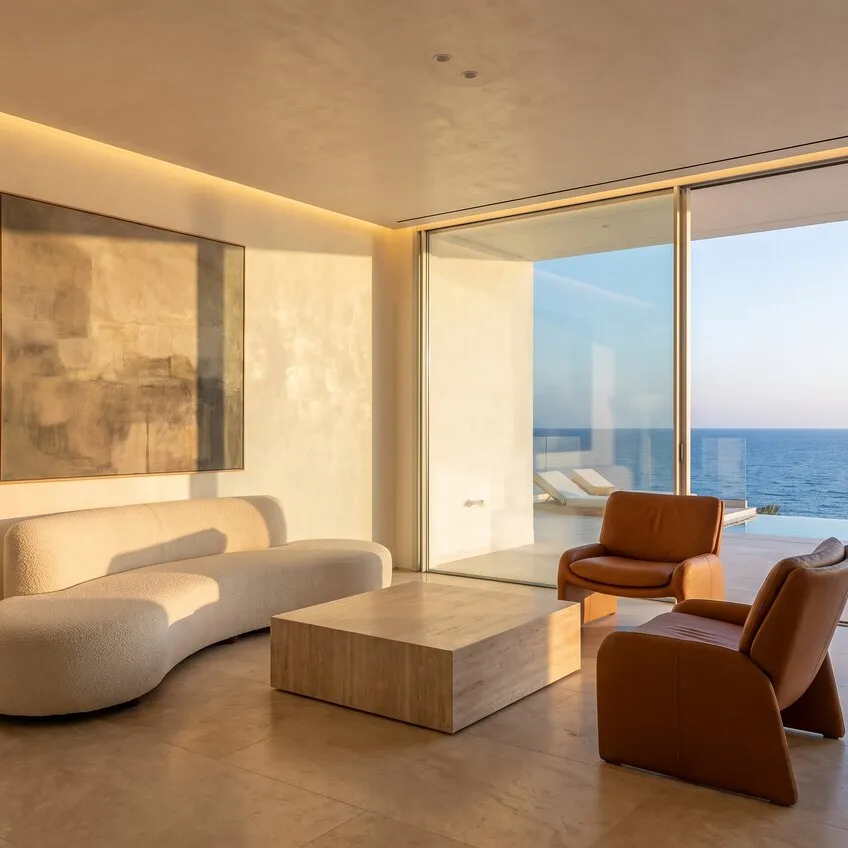
Mouldings are not just for classic interiors. Slim wall mouldings create “frames” in neoclassical and modern rooms, a shadow-gap profile at the ceiling makes it look higher, and a concealed cornice with LED lighting gives soft indirect light. In rental properties, neat decor helps a place stand out in photos and feel memorable without costly alterations.
This service has clear limits. Curtain rails, painted murals and wall panels are separate jobs with their own specialists. If you want to pair mouldings with an artwork on the wall, have a look at murals and wall decor.
Profile and material
Decorative elements are made from plaster, polyurethane, high-density polymer and polystyrene. Plaster gives the crispest detail and suits restoration and complex shapes; it can be cast to a bespoke pattern. Polyurethane and high-density polymer are lighter, more impact-resistant and easier to fit, which makes them a common choice for apartments and commercial spaces. In humid coastal air and in bathrooms, the material and adhesive must tolerate moisture, and in rooms with direct sun they must cope with temperature swings. The profile size is matched to the ceiling height: a heavy cornice overwhelms a low room, while a slim one gets lost in a large hall.
Setting out the composition
Before fitting, the specialist marks out the composition on walls and ceiling: how far the frames sit from the floor, corners and doors, the rhythm of the panels, the centre of the rose above the light fitting. Ideally you see the layout in advance (on a sketch or pencilled straight on the wall), so you can judge the proportions before anything is glued in place.
What the work includes
- choosing profiles or making elements to a pattern;
- preparing the surface and setting out the composition;
- mitre cutting, fitting joints and fixing with adhesive and fixings;
- filling joints, gaps and junctions with the wall and ceiling;
- sanding and priming ready for paint.
Painting is not always part of moulding installation: some specialists hand over primed elements, others paint them together with the walls. Agree this in advance and clarify who is responsible for the final colour and for protecting the finished surfaces.
Finding the right moulding installer
Look for experience with similar jobs: fitting ready-made polyurethane mouldings, casting plaster elements to a pattern and restoring old decor call for different skills. Ask for close-ups rather than wide shots: mitred corners, filled joints and straight runs along long walls reveal the quality of the fitting at once.
To quote for mouldings, a specialist needs the ceiling height and wall lengths, photos of the room, a few pictures of decor you like and the designer’s drawings if they exist. Say whether painting and a lit cornice are part of the job, since that changes the scope and the skills you need.